ADVANTAGES
Internet empowers people. You have seen it in social networking, you have seen it in advertising. Now we see it in news reporting.
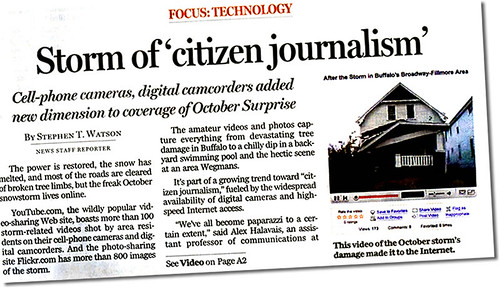
With the Internet and its many platforms, the average citizen can report news.
For example, in Myanmar in 2007, citizen witnesses used cell phones and email to beam out images of bloodied protesters and street fires.
The recent events in japan saw the news spread first via twitter and Facebook, and then through official sources.
Why? First, the Internet is ubiquitous, it goes everywhere like wet sand on your body. With a single click, your message, your report, spreads. Anyone anywhere can read it. All the benefits that come with the Internet serve the spread of citizen journalism: its ubiquity, global reach, speed, everything.
Secondly, Most of the time, these people are "on the scene" and able to provide readers with a more first hand account of events than any Reuters reporter ever could. There is a certain level of "authenticity" when it is reported by a normal person and not a paid journalist. Usually with a paid journalist, you do not know where his loyalties lie: does he really report the news or is he just doing it for the money? Will he report accurately if he is not on the scene experiencing it first hand?
DISADVANTAGES
The first disadvantage is definitely the professionalism factor. I have personally read much of these "citizen journalists" and i safely say that there is a reason why we still have paid journalists. They are paid because they are trained. They know what is important to report and they are held accountable.
With citizen journalists, they are not as accountable for what they report.
Furthermore, most of them are not trained as reporters.
Citizen journalism sometimes devolve into opinion.
The second disadvantage links in to the question of what is considered "news". Take a look at Stomp, Singapore's very own "citizen journalism" website.
http://www.stomp.com.sg/

Most "news" by the citizen journalists are shallow, mundane happenings.
Someone was sleeping on the MRT and not giving his seat up for an old man, someone spat on the grass, someone saw someone else drunk.
Its funny yes, its attention grabbing but is it "news worthy"?
Newsworthiness of an item is defined as being of sufficient interest to the public and of sufficient impact to warrant a printing.
How impactful on our greater society is one dude spitting into the grass? That is not news. Someone blowing up a train station, now that is news.
I feel that Citizen journalism challenges the journalistic values like accuracy fairness and balance.
Content online lacks professionalism and quality control. This ends up damaging credibility.
Citizen journalism might not be as influential in a very developed media environment like USA. But in countries rife with turmoil or with little media development, citizen journalists might be able to enact social change
As stable as Singapore is, i find that Citizen journalism will also not be influential here, especially not for hard news. It might be good for trivial matters like drunk people in Holland village but for anything deeper and more insightful, my love is with New York Times.

No comments:
Post a Comment