Sunday, April 24, 2011

Future of Internet and Computers


What does our future hold for us??

I for one would like to see the realisation of many concepts that were first realised in science fiction.
Remember those little computers in Star Trek that had all the information in the world and was just the size of a hand phone? That's reality now in the form of smart phones. This is called integration. One device that is a communication device, an information laden encyclopedia, a tracking beacon, a laser gun............ok maybe not the laser gun, but you get my point. It is everything in one. Sooner or later, they might just integrate a tazer into the iPod 9 for the more dangerous neighborhoods. Or maybe a remote control function for your HD TV. In fact i just discovered that you can sync your iPhone to your MacBook and use the iPhone to navigate a PowerPoint presentation.


Its a little complicated, but it works. In the future it would not be this complicated. Just a tap of an icon and you get control after you sync to a unique IP address-like code that is unique for each computer.


The next change that i see in the near future would be a fully networked world. Internet routers would be everywhere such that one could access the net anytime, anyplace. Tech is getting cheaper by the day. This would then cause a decline in the demand for paid Internet provider services. Sooner or later, paid Internet service would be a dying trend, only reserved for people who desperately need their 1GBPS download speed or lag-less game play. And even that would be dirt cheap. The casual PC user who just needs to surf the web, download an mp3 or 2 and play the occasional game could live off the worldwide free wireless system forever.

A talking iPhone anyone? Yes, my third prediction would be artificial intelligence. In a positive light, they would be benign artificial intelligence beings, like jolly kind butler. Yes, there is web 3.0 already, BUT my prediction is an extension of that web 3.0 concept. Imagine an internet where AI entities exist as distinct, separate beings, kind of like non-player characters in a video game that you interact with. They will be just like real people, interacting in chat rooms, online forums, adding you as a friend on Facebook etc. The catch is THEY ARE NOT REAL. Only virtual A.I constructs. I feel that such virtual AI constructs would be a natural extension of the AI used in web 3.0. After a AI learns about your reading habits, your browsing habits, what you like, where you surf, when you come online and how you access the net, it would naturally proceed to the next logical question..........."WHY". That, it would only learn through interaction once they inevitably become self aware.

So who knows? They next friendly Facebook user you meet might be a virtual artificial intelligence. They will talk to you, ask you how your day was, BUT THEY DON'T EXIST.
Everyone will have their own virtual friend and no one can ever be lonely ever again.


Will the internet take over our lives?? Will integration become so prevalent that we ourselves become a part of the internet?
Only time will tell.

Saturday, April 9, 2011

AMVts (Anime Music Video trailers)

First, what is an "Anime Music Video"? It is a fan made video combining footage from an animated production with seemingly unrelated audio. But together the final product takes on a whole new level of meaning, it is an art form in itself. As a subculture of anime fandom (which is already a sub genre), making and posting anime music videos is a hot pastime among fans.

Now the sub-sub genre of "Anime music video trailers"(AMVt) is not as wide spread but is not less vibrant. This involves animation footage as well but synced to audio sourced from movie trailers.

These are more prevalent on sites like YouTube. The only reason for that is copyright infringements that AMVs incur. Unlike AMVs which have legal implications thanks to the user using a full licensed song for audio, AMVts do not.


As long as one uses less than 10% of a particular show's footage, he is free from legal implications. And trailers become public domain already, hence using them is totally legal under Fair Use Law. AMVs using full songs are regularly taken off YouTube but since AMVts are using audio from trailers that are released to public domain, there is a small legal loophole there.

One may scoff and say "hey, anyone can cut and paste footage and audio".


But i say that not everyone can do so WITH SKILL. Making an AMVt is actually more complex than a simple AMV. IT takes a good amount of skill to actually make an AMVt because not only do you have to sync the music with footage that seems appropriate to the tune of the trailer music, you have to sync the sound effects and the dialogue. So if the original trailer featured a "bump" sound at a certain point you have to find appropriate footage that features something that goes "bump". If the audio features a gunshot, you have to find footage with a gunshot. Failure to do so would result in a very poorly synced video and a complete loss of face.

It is NOOBISH to not sync the sound effects properly.

Here are the other kinds of mistakes that one can make when creating a AMVt.

1) poorly synced sound effects - as explained earlier

2) no effort to sync mouth flaps to dialogue. - when the audio line is obviously something like "hello there" (3 syllables) but the video shows a mouth moving to only 1 syllable. The result looks stupid.

3) blatant use of repeated footage - sometimes repeating footage is a necessary evil but at least use post production editing tools to not make it look so blatantly like repeated footage.

4) using footage that make no sense - unless the resulting AMVt is meant for comedic purposes or as a parody, syncing footage that makes no sense together with the audio just.........makes no sense. A stupid and lazy move by the editor.


Just compare between these 2. Which do you prefer?

Apple Vs Google


Apple vs Google. We could talk all day about their products or their services. But in the end, i feel that Apple cannot be compared to Google.

For something to be compared to another, they have to be operating on similar "grounds". A software company can be compared to another software company. Likewise, a telephone company should be compared to another telephone company.

Google and Apple however, are not similar enough to be compared. It will be like comparing a fruit to a book. Even their logos (seen above) are so different. Google's is a colorful word art while Apple is a mono colored picture.

1) Google deals in online services and internet technology.

Data, search engines, productivity tools, advertising. According to market research Google is the dominant search engine in the United States market, with a market share of 65.6%.That is what Google plays with. Software and apps that are constantly expanding. Now they have a wide variety of such web tools are and looking into cloud computing. A rudimentary cloud computing system can be seen on Google Documents.
Apple on the other hand deals in physical products, both hardware and software. Computer products like the iPad, personal computers and internet browsers. Even the software tha Apple releases is rather different from that of Google. Apple only makes proprietary software that would work on their own products. Google's software on the other hand is more flexible and can work on any computer system. Their "areas of work" do not overlap at all with Google.

2) Google tried to enter the phone business? Wrong. What google did was make their "Android" software for phones and not a phone itself, compared to Apple's Iphone which is an actual physical phone.


How is one to compare a sofware to an actual physical product? Can we compare iPhone's sleek design to perhaps the design of Android's digital logo?
Sure you can compare how fast their respective phone web browsers take to access a web page, but that is really making a mountain out of a mole hill. And again, speed could be dependant on hardware.

3) Both Google and Apple have different revenue systems too.
Apple get a cut from all the products they sell.

And since their products are proprietary and can only work best when used with otther Apple products, Apple ensures its base of buyers.
Google on the other hand gains revenue by selling the rights to their software and through advertising.

Google advertisements can be placed on third-party websites in a two-part program. Google's Adwords allows advertisers to display their advertisements in the Google content network, through either a cost-per-click or cost-per-view scheme. The sister service, Google Adsense, allows website owners to display these advertisements on their website, and earn money every time ads are clicked.


Perhaps a more satisfactory comparison would be made with Apple Vs Sony or Google Vs Microsoft.

My conclusion: Apple and Google are too different to even start a comparison.

Sunday, April 3, 2011

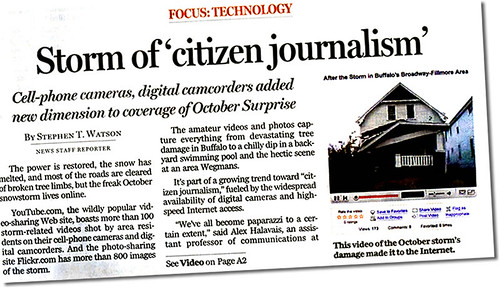
citizen journalism with the internet


ADVANTAGES
Internet empowers people. You have seen it in social networking, you have seen it in advertising. Now we see it in news reporting.
With the Internet and its many platforms, the average citizen can report news.

For example, in Myanmar in 2007, citizen witnesses used cell phones and email to beam out images of bloodied protesters and street fires.
The recent events in japan saw the news spread first via twitter and Facebook, and then through official sources.

Why? First, the Internet is ubiquitous, it goes everywhere like wet sand on your body. With a single click, your message, your report, spreads. Anyone anywhere can read it. All the benefits that come with the Internet serve the spread of citizen journalism: its ubiquity, global reach, speed, everything.

Secondly, Most of the time, these people are "on the scene" and able to provide readers with a more first hand account of events than any Reuters reporter ever could. There is a certain level of "authenticity" when it is reported by a normal person and not a paid journalist. Usually with a paid journalist, you do not know where his loyalties lie: does he really report the news or is he just doing it for the money? Will he report accurately if he is not on the scene experiencing it first hand?

DISADVANTAGES
The first disadvantage is definitely the professionalism factor. I have personally read much of these "citizen journalists" and i safely say that there is a reason why we still have paid journalists. They are paid because they are trained. They know what is important to report and they are held accountable.
With citizen journalists, they are not as accountable for what they report.
Furthermore, most of them are not trained as reporters.
Citizen journalism sometimes devolve into opinion.

The second disadvantage links in to the question of what is considered "news". Take a look at Stomp, Singapore's very own "citizen journalism" website.
http://www.stomp.com.sg/


Most "news" by the citizen journalists are shallow, mundane happenings.
Someone was sleeping on the MRT and not giving his seat up for an old man, someone spat on the grass, someone saw someone else drunk.
Its funny yes, its attention grabbing but is it "news worthy"?
Newsworthiness of an item is defined as being of sufficient interest to the public and of sufficient impact to warrant a printing.
How impactful on our greater society is one dude spitting into the grass? That is not news. Someone blowing up a train station, now that is news.

I feel that Citizen journalism challenges the journalistic values like accuracy fairness and balance.
Content online lacks professionalism and quality control. This ends up damaging credibility.

Citizen journalism might not be as influential in a very developed media environment like USA. But in countries rife with turmoil or with little media development, citizen journalists might be able to enact social change

As stable as Singapore is, i find that Citizen journalism will also not be influential here, especially not for hard news. It might be good for trivial matters like drunk people in Holland village but for anything deeper and more insightful, my love is with New York Times.