Sunday, April 24, 2011

Future of Internet and Computers


What does our future hold for us??

I for one would like to see the realisation of many concepts that were first realised in science fiction.
Remember those little computers in Star Trek that had all the information in the world and was just the size of a hand phone? That's reality now in the form of smart phones. This is called integration. One device that is a communication device, an information laden encyclopedia, a tracking beacon, a laser gun............ok maybe not the laser gun, but you get my point. It is everything in one. Sooner or later, they might just integrate a tazer into the iPod 9 for the more dangerous neighborhoods. Or maybe a remote control function for your HD TV. In fact i just discovered that you can sync your iPhone to your MacBook and use the iPhone to navigate a PowerPoint presentation.


Its a little complicated, but it works. In the future it would not be this complicated. Just a tap of an icon and you get control after you sync to a unique IP address-like code that is unique for each computer.


The next change that i see in the near future would be a fully networked world. Internet routers would be everywhere such that one could access the net anytime, anyplace. Tech is getting cheaper by the day. This would then cause a decline in the demand for paid Internet provider services. Sooner or later, paid Internet service would be a dying trend, only reserved for people who desperately need their 1GBPS download speed or lag-less game play. And even that would be dirt cheap. The casual PC user who just needs to surf the web, download an mp3 or 2 and play the occasional game could live off the worldwide free wireless system forever.

A talking iPhone anyone? Yes, my third prediction would be artificial intelligence. In a positive light, they would be benign artificial intelligence beings, like jolly kind butler. Yes, there is web 3.0 already, BUT my prediction is an extension of that web 3.0 concept. Imagine an internet where AI entities exist as distinct, separate beings, kind of like non-player characters in a video game that you interact with. They will be just like real people, interacting in chat rooms, online forums, adding you as a friend on Facebook etc. The catch is THEY ARE NOT REAL. Only virtual A.I constructs. I feel that such virtual AI constructs would be a natural extension of the AI used in web 3.0. After a AI learns about your reading habits, your browsing habits, what you like, where you surf, when you come online and how you access the net, it would naturally proceed to the next logical question..........."WHY". That, it would only learn through interaction once they inevitably become self aware.

So who knows? They next friendly Facebook user you meet might be a virtual artificial intelligence. They will talk to you, ask you how your day was, BUT THEY DON'T EXIST.
Everyone will have their own virtual friend and no one can ever be lonely ever again.


Will the internet take over our lives?? Will integration become so prevalent that we ourselves become a part of the internet?
Only time will tell.

Saturday, April 9, 2011

AMVts (Anime Music Video trailers)

First, what is an "Anime Music Video"? It is a fan made video combining footage from an animated production with seemingly unrelated audio. But together the final product takes on a whole new level of meaning, it is an art form in itself. As a subculture of anime fandom (which is already a sub genre), making and posting anime music videos is a hot pastime among fans.

Now the sub-sub genre of "Anime music video trailers"(AMVt) is not as wide spread but is not less vibrant. This involves animation footage as well but synced to audio sourced from movie trailers.

These are more prevalent on sites like YouTube. The only reason for that is copyright infringements that AMVs incur. Unlike AMVs which have legal implications thanks to the user using a full licensed song for audio, AMVts do not.


As long as one uses less than 10% of a particular show's footage, he is free from legal implications. And trailers become public domain already, hence using them is totally legal under Fair Use Law. AMVs using full songs are regularly taken off YouTube but since AMVts are using audio from trailers that are released to public domain, there is a small legal loophole there.

One may scoff and say "hey, anyone can cut and paste footage and audio".


But i say that not everyone can do so WITH SKILL. Making an AMVt is actually more complex than a simple AMV. IT takes a good amount of skill to actually make an AMVt because not only do you have to sync the music with footage that seems appropriate to the tune of the trailer music, you have to sync the sound effects and the dialogue. So if the original trailer featured a "bump" sound at a certain point you have to find appropriate footage that features something that goes "bump". If the audio features a gunshot, you have to find footage with a gunshot. Failure to do so would result in a very poorly synced video and a complete loss of face.

It is NOOBISH to not sync the sound effects properly.

Here are the other kinds of mistakes that one can make when creating a AMVt.

1) poorly synced sound effects - as explained earlier

2) no effort to sync mouth flaps to dialogue. - when the audio line is obviously something like "hello there" (3 syllables) but the video shows a mouth moving to only 1 syllable. The result looks stupid.

3) blatant use of repeated footage - sometimes repeating footage is a necessary evil but at least use post production editing tools to not make it look so blatantly like repeated footage.

4) using footage that make no sense - unless the resulting AMVt is meant for comedic purposes or as a parody, syncing footage that makes no sense together with the audio just.........makes no sense. A stupid and lazy move by the editor.


Just compare between these 2. Which do you prefer?

Apple Vs Google


Apple vs Google. We could talk all day about their products or their services. But in the end, i feel that Apple cannot be compared to Google.

For something to be compared to another, they have to be operating on similar "grounds". A software company can be compared to another software company. Likewise, a telephone company should be compared to another telephone company.

Google and Apple however, are not similar enough to be compared. It will be like comparing a fruit to a book. Even their logos (seen above) are so different. Google's is a colorful word art while Apple is a mono colored picture.

1) Google deals in online services and internet technology.

Data, search engines, productivity tools, advertising. According to market research Google is the dominant search engine in the United States market, with a market share of 65.6%.That is what Google plays with. Software and apps that are constantly expanding. Now they have a wide variety of such web tools are and looking into cloud computing. A rudimentary cloud computing system can be seen on Google Documents.
Apple on the other hand deals in physical products, both hardware and software. Computer products like the iPad, personal computers and internet browsers. Even the software tha Apple releases is rather different from that of Google. Apple only makes proprietary software that would work on their own products. Google's software on the other hand is more flexible and can work on any computer system. Their "areas of work" do not overlap at all with Google.

2) Google tried to enter the phone business? Wrong. What google did was make their "Android" software for phones and not a phone itself, compared to Apple's Iphone which is an actual physical phone.


How is one to compare a sofware to an actual physical product? Can we compare iPhone's sleek design to perhaps the design of Android's digital logo?
Sure you can compare how fast their respective phone web browsers take to access a web page, but that is really making a mountain out of a mole hill. And again, speed could be dependant on hardware.

3) Both Google and Apple have different revenue systems too.
Apple get a cut from all the products they sell.

And since their products are proprietary and can only work best when used with otther Apple products, Apple ensures its base of buyers.
Google on the other hand gains revenue by selling the rights to their software and through advertising.

Google advertisements can be placed on third-party websites in a two-part program. Google's Adwords allows advertisers to display their advertisements in the Google content network, through either a cost-per-click or cost-per-view scheme. The sister service, Google Adsense, allows website owners to display these advertisements on their website, and earn money every time ads are clicked.


Perhaps a more satisfactory comparison would be made with Apple Vs Sony or Google Vs Microsoft.

My conclusion: Apple and Google are too different to even start a comparison.

Sunday, April 3, 2011

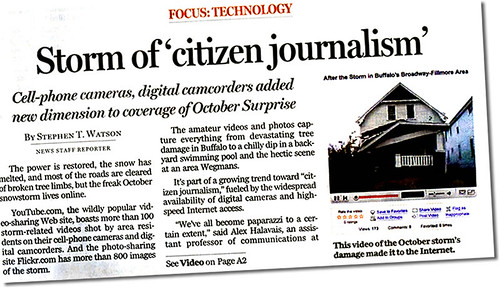
citizen journalism with the internet


ADVANTAGES
Internet empowers people. You have seen it in social networking, you have seen it in advertising. Now we see it in news reporting.
With the Internet and its many platforms, the average citizen can report news.

For example, in Myanmar in 2007, citizen witnesses used cell phones and email to beam out images of bloodied protesters and street fires.
The recent events in japan saw the news spread first via twitter and Facebook, and then through official sources.

Why? First, the Internet is ubiquitous, it goes everywhere like wet sand on your body. With a single click, your message, your report, spreads. Anyone anywhere can read it. All the benefits that come with the Internet serve the spread of citizen journalism: its ubiquity, global reach, speed, everything.

Secondly, Most of the time, these people are "on the scene" and able to provide readers with a more first hand account of events than any Reuters reporter ever could. There is a certain level of "authenticity" when it is reported by a normal person and not a paid journalist. Usually with a paid journalist, you do not know where his loyalties lie: does he really report the news or is he just doing it for the money? Will he report accurately if he is not on the scene experiencing it first hand?

DISADVANTAGES
The first disadvantage is definitely the professionalism factor. I have personally read much of these "citizen journalists" and i safely say that there is a reason why we still have paid journalists. They are paid because they are trained. They know what is important to report and they are held accountable.
With citizen journalists, they are not as accountable for what they report.
Furthermore, most of them are not trained as reporters.
Citizen journalism sometimes devolve into opinion.

The second disadvantage links in to the question of what is considered "news". Take a look at Stomp, Singapore's very own "citizen journalism" website.
http://www.stomp.com.sg/


Most "news" by the citizen journalists are shallow, mundane happenings.
Someone was sleeping on the MRT and not giving his seat up for an old man, someone spat on the grass, someone saw someone else drunk.
Its funny yes, its attention grabbing but is it "news worthy"?
Newsworthiness of an item is defined as being of sufficient interest to the public and of sufficient impact to warrant a printing.
How impactful on our greater society is one dude spitting into the grass? That is not news. Someone blowing up a train station, now that is news.

I feel that Citizen journalism challenges the journalistic values like accuracy fairness and balance.
Content online lacks professionalism and quality control. This ends up damaging credibility.

Citizen journalism might not be as influential in a very developed media environment like USA. But in countries rife with turmoil or with little media development, citizen journalists might be able to enact social change

As stable as Singapore is, i find that Citizen journalism will also not be influential here, especially not for hard news. It might be good for trivial matters like drunk people in Holland village but for anything deeper and more insightful, my love is with New York Times.

Sunday, March 27, 2011

Internet and politics


For a time, politics was an untouchable concept limited to the people in power. It happened in senates, it happened in Parliament, and all the citizens could do was watch. The only time when the citizens could participate was during elections. The citizens voted. Participation started and ended there.

The campaigns leading up to the election of President Barack Obama in USA saw the heavy involvement of online social networking. The internet was used to rally support, to organise gatherings, and even to "shoot" the opposition.

So will we ever have such a dynamic online political environment here in Singapore??

Well the path to the 2011 elections.................seem to indicate otherwise.

Perhaps it could be Singapore's small size but online activity about the elections has been rather tame. No fiery rants about the opposition, no rally cries for change. No famous fan made videos either making fun of one political party or expressing love for another party (like the "Obama girl" video)

Personally, i feel that this is not the fault of restricted online media. The internet is anything but restrictive. The fault for the less that enthusiastic pre-election atmosphere online lies in the less than enthusiastic public.

Are Singaporeans Apathetic toward politics?
The answer is YES.

But the punchline of the joke is that it is not our fault. It is the system. Singaporeans just do not have the time or the energy to be passionate about politics. All their energy is already being sapped in their day to day lives, just trying to live and get by. Our society is so stressful, so competitive that a typical Singaporean youth would be more bothered with his upcoming project deadline than silly old politics.

It is a simple matter of the costs outweighing the gains. What will you gain from letting your political views about opposition parties be heard online. I doubt that the government actually pays any attention to those few online rants that already exist.

It is a vicious cycle.
People start these online campaigns in the hope to illicit a reaction.
The public, being as apathetic as they are, will have little reaction.
The government will either take you to court (like what they usually do when they encounter politically defaming remarks online) or not bother at all.

Thus in the end, any online politically motivated movement will fail in Singapore.

Multimedia marketing - MOCCA fail


Yikes.

Online classifieds are nothing new, but in 2007, Mediacorp singapore launched "mocca.com", an online multimedia marketing site. The word "Mocca" is a short form acronym which stands for "MediaCorp Online Communities and Classified Advertising".

The site allowed users to create and post up their own multimedia advertisements for products or services.

Classified advertisements can be posted on MOCCA for free except in two categories: property and vehicles. Ads in those two categories are charged at 50 cents a day, with a minimum duration of 14 days. (real clever as that equals $7 right up front payment).

These paid ads can have up to 10 images and a video link.

The free ads in other categories can have images and videos too. Up to 2 images and 1 video link. Advertisers can upgrade these ads by paying a similar rate to the vehicle and property category ads. 50 cents a day (S$7 for the minimum 14 days duration) and upload up to 10 images.

All ads can also be further enhanced, at a cost of S$2 to S$4 a day, by having them highlighted on the category or main home pages.

While it might have been an innovative idea on paper, the execution of the idea is just...........funny. Initial advertising for the site (as seen in the video link above) was met with laughs and jokes.

Basically, no one took the idea seriously. No one took the site seriously.

AS of now, its popularity is no where near that of other marketing sites. Most ads on the site are traditional word ads with very few actual multimedia ads that mediacorp originally intended that users post.

Therefore, as a multimedia marketing site, Mocca.com is a complete failure.
A joke, just like how its advertisements make it out to be.

Saturday, March 12, 2011

Of Viruses and Worms


My favorite singer. Always sings the most hilarious parodies.

This one is about a computer virus. The song takes the form of a virus alert warning gives an insight into the dangers of computer viruses in a fun filled way.

Some creative liberties were taken, since it is obvious viruses will NOT neuter your dog. But all in good fun i guess.

There is an implied second meaning behind this "virus alert". How do you know a "virus alert" is not the virus itself? After all, the easiest way for an enemy to strike is to pose as a friend.

Think about it.

Here are the lyrics for anyone who wants to sing along
Hey, everyone, listen up, your attention if you please
Really wanna give you a warning
'Cause I found out this morning
About a dangerous, insidious computer virus
If you should get an email with the subject, 'stinky cheese'
Better not go taking your chances
Under no circumstances, should you open it
Or else it will

Translate your documents into Swahili
Make your TV record "Gigli"
Neuter your pets, and give you laundry static cling
Look out!
It?s gonna make your computer screen freeze
Look out!
Erase the Easter eggs off your DVDs
Look out!
Erase your hard drive and your backups too
And the hard drive of anyone related to you

Virus alert!
Delete immediately before someone gets hurt!
Forward this message on to everybody

Soon, very soon, it will make all the paint peel off your walls
It?ll make your keyboard all sticky
Give your poodle a hickey
And invest your cash in stock in Euro Disney
Then, it will tie up your phone, making crank long-distance calls
It?ll set your clocks back an hour and start clogging the shower
So just trash it now, or else it will

Decide to give you a permanent wedgie,
Legally change your name to Reggie,
Even mess up the pH balance in your pool

Look out!
It?s gonna melt your face right off your skull
Look out!
And make your iPod only play Jethro Tull
Look out!
And tell you knock-knock jokes while you?re trying to sleep
Look out!
And make you physically attracted to sheep
Look out!

Steal your identity and your credit cards
Look out!
Buy you a warehouse full of pink leotards
Look out!
Then cause a major rift in time and space
And leave a bunch of Twinkie wrappers all over the place
That?s right it?s a...

Virus alert!
Delete immediately before someone gets hurt!
Forward this message on to everybody

Virus alert!
Delete immediately before someone gets hurt!
Forward this message on to everybody
Warn all your friends, send this to everybody
Tell everyone you know, tell everybody now

If you get infected, you?ll wish you had never been born
So before it emails your grandmother all of your porn
Turn off your computer and make sure it powers down
Drop it in a forty-three-foot hole in the ground
Bury it completely; rocks and boulders should be fine
Then burn all the clothes you may have worn any time you were online!

Virus alert!
Delete immediately before someone gets hurt!
Forward this message on to everybody

Virus alert!
Delete immediately before someone gets hurt!
Forward this message on to everybody

Virus alert!
Delete immediately before someone gets hurt!
Forward this message on to everybody
Warn all your friends, send this to everybody
Tell everyone you know, tell everybody now
What are you waiting for?
Just hurry up and forward this to every single person that you know!
Hit send right now!

Saturday, March 5, 2011

playing with Windows movie maker

Windows movie was never anything new to me. All the way back into my polytechnic days, i was playing around with the tools. I have an active youtube account seen here

http://www.youtube.com/user/Xamtaro

The only problem is that i do not like to take my own footage. Without a professional camera, editing tools, lens filters and a lot of time, such footage would look cheap and amateurish . As a result, i prefer to work with pre-shot footage and sound.

My hobby is creating fan-trailers.
That is a fake movie trailer syncing sound from an existing movie trailer to footage from an unrelated film.

Now you might scream "copyright infringement" but then i will scream "right of fair use".

As long as i use less than 10% of a film, i am entitled to right of fair use.
Trailers, both footage and sound, are covered under fair use as well so long as i do not make a profit from them.

OF course i do not desire any profit, but i would appreciate a couple of "likes" eh?

here are some of the vids that i am most proud of. Try comparing the footage in those trailers to that featured in the original trailers. The similarities are uncanny.


E Learning. Classroom of the future

As we are moving into the digital domain, so too will our classrooms. There was a theory put forth in class that in the future, we would no longer need classrooms. All learning would be online. Students and teachers would log into an online classroom from the comfort of their own home and have lessons in a virtual space. Almost like going to school in that MMORPG "Second Life".

The implications for this theory are astounding. For starters, we would not have to build school buildings anymore. Anyone who wants to learn can get a good computer and a stable internet connection. At most $2000. No more hefty school fees since you no longer have to rent facilities or pay for teachers' transport or your own transport. You pay for the knowledge gained.

With the use of customizable avatars, in-class racism or teachers' biases based on students' appearance would be null and void. There will be no such thing as "the ugly girl" or "the dumb jock". People can look however they want. There will no longer be cases of social outcasting based on looks. No more long commutes in the morning traffic jam, no more blaming a slow bus for being late for class.

Despite all these benefits, i remain sceptical. Knowledge is not the only thing we learn in school. There is a whole array of soft skills that we learn, for example, the value of discipline. The discipline to get up from bed at 6am in the morning and drag yourself to school, sit through a lesson and then do revision afterwards. With a digital classroom, you no longer need that level of discipline.

And be honest. Many students goof off during lessons nowadays. While the teacher is talking, they are chatting with their friends, they are sending each other handphone messages, they are tweeting. Without the physical supervision of a teacher's presence, it will be so much easier to goof off. Goofing off in the future classroom would take the "art" to a whole new level. Students would leave their avatar in study mode while they switch windows to play a video game or open up an instant messenger to chat with their friends. There would be more and more creative ways to goof off.

Cheating would also be so much easier. Need I say why?

Playing truant would made made more convenient with the creation of "bot" avatars which will go to school for you and clock in your attendance while the actual student is watching a movie.

The bottom line is this: People lack the discipline to be allowed into the proposed digital classroom of the future. Such a way of learning will give rise to a whole new generation of smart kids, but undisciplined, spoiled brats.
Therefore, the classroom of the future would just be like the classroom of today. Only with more high tech computers.

Saturday, February 19, 2011

E-Commerce fail

For every Facebook, there are 10 more "fail-books". But how do we know this? How do we know that there are many more e-commerce failures than successes? First, it is really easy to set up an e-commerce site. Every e-commerce course that charges hundreds of dollars to learn how to easily set up a simple e-commerce site would tell you this. Judging by the number of people who signed up for such courses back during the dotcom bubble, there should be millions of them.

Instead try to name the reputable ones that people keep going back to. Off the bat, i could only come up with 12. There might be only hundreds of successful e-commerce operations in the worlds. Note that this prediction does not include companies who are already "brick and mortar" operations and whose e-commerce sites are merely a supplement and an extension to their regular offline operations. So what happened to those that were not successful? We never hear from them again. The news and other official sources keep harping on those who were successful, seldom do you hear about the failures, and this leads to the perception that e-commerce will lead to big bucks.


So how do they fail so epically? Here are 5 reasons

1) Lack of a profit plan
You want to attract people to buy from you. The easiest enticement is customer benefits. Free shipping, lower price, extra goodies, you name it. These are surefire ways to entice a customer and cause him or her to choose you over your competitors. But some people go too far. A sad example would be "pets.com" which dealt in pet accessories and supplies. In order to attract customers, they sold their products at insanely low prices and free shipping for bulk purchases. This got a point where they were generating a loss and had to shut down.
Dumb.

2) Bad site design
Online equals speed. But what if it takes longer to find a product you want in an online store than in a brick and mortar store? Badly designed search functions and lengthy list turn people away. People who visit online stores want speed and efficiency. They want categories that accurately describe the product. Just putting a bunch of links of a page is not good enough. Last but not least, is the aesthetics. A plain white page is just boring, but having everything in bright gaudy pink is clearly overdoing it. A simple but sincere design is all that is needed. Look at the successful ones like amazon.com and you will see that the colors are very basic, the site is not decked out in bells and whistles and it is easy to navigate.

3) Not building clientele or community
Customers are one of the best forms of publicity. If they liked the site, they will tell others about it. Having a system where customers can share reviews or feedback about products and services can help to improve the e-commerce operation. Many e-commerce sites that fail do not have this function. The first implied message is a lack of openness and customers hate that. It implies that the e-commerce site might have something to hide, like maybe it is scared that customers will complain about bad service or products. Having a feedback system and an open forum to build community shows confidence in both the business and the customers. That confidence will be returned in kind.

4) They waited too long
Market saturation was something that caused many online e-commerce sites to go bust. Most of those that were left were the "first movers" . Customers adore innovation, they love sites that offer something new that no other competitors offer. One bad mistake that sites make is that they do not get their innovation out into the market fast enough. Sure one has to do research and fine tune everything, ensure all is in good working order. E-commerce is not without risks and it would be foolish to "jump in" impulsively. However, it is also foolish to wait too long. Someone else might have already come out with a similar innovation before you thus effectively making him the "first mover" instead of you. He gets the recognition and you are stuck with the unfair label of "copycat".

5) They did not wait long enough
Research, research, research. Market research is very important. Any good e-commerce operation has to know what the consumer wants and whether there is a substantial market size for the products or services that the site is going to sell. You do not, for example, set up a business to ship chicken from China during a bird flu outbreak. There has to be a demand, and may e-commerce operations die out because they offer products and services that hardly anyone had an urgent need for. A good example is "photopoint.com" which dealt in physical camera film negatives. Too bad they jumped into the fray right when digital cameras were becoming popular. No one had a need for physical film.


And here are what i feel are the top 10 e-commerce failures
# 1 Webvan.com (1999-2001)
# 2 Pets.com (2000)
# 3 Kozmo.com (1998-2001)
# 4 Flooz.com (1998-2001)
# 5 eToys.com (1997-2001) # 6 Boo.com (1998-2000)
# 7 MVP.com (1999-2000)
# 8 Go.com (1998-2001)
# 9 Kibu.com (1999-2000)
# 10 GovWorks.com (1999-2000)

Friday, February 11, 2011

Social network site showdown

Social networking is a hot recent phenomenon sweeping the globe. From Facebook and twitter to Friendster and myspace, internet users are spoilt for choice when it comes to entering the world of social media. Think of social networking as a subset of the larger all-encompassing category of “social media”. While social media only allows you to be both consumer and producer of online content, social networking is specifically meant to connect people over the internet. Similar to how one has a network of friends in real life, social networking is just the extension of that real life network concept into the digital realm.

The names "Friendster" and "Facebook" should be familiar to most modern individuals who have computer access. The focus of today's blog is a small "compare and contrast" between the two famous social networking sites.

1) First impressions

- This is Facebook's greeting page


Simple hues of blue, a detailed "registration sheet" for new members and meaningful and effective image showing the concept of an online social network: connecting people from all countries across the globe irregardless of geographical distance. There is even a brief description of what Facebook does. The impression is a down to earth professionalism and an unpretentious taste that will appeal to anyone

Basic colors of green and white are accompanied by two supposedly cute, but badly rendered, manga styled characters in weird costumes. The images change every few hours, giving a lot of variety. While not as "wordy" as Facebook, nor as dull thanks to the pictures. Unlike Facebook, in which the registration requires 7 different details, Friendster just requires 1 for now, thus making signing up for newcomers more hassle free. The problem is the little blurb which describes what friendster is. Friendster is described as a "gaming destination" and ends with "come and see what all the fuss is about!". The impression is a more juvenile one as compared to the professional air of Facebook. One gets the feeling that this is more for the kids.


2) interface

Today, the user interface of Facebook and Friendster are not too different. It is better not to say who copied who. Both have similar widgets like a status update, a wall, picture albums, a friends finding option, games; Even the layout is rather similar. The difference is the respective "emphasis" of each site. Facebook tends to place emphasis on the personal profile and the friends finding. On the other hand, friendster emphasises more on meeting new people and keeping up with friends through the games. The focus is on fun whereas Facebook's focus is more on the actual "networking". Also, the ads that pop up for both sites are a little different.

3) Ease of use

Both Facebook and the current incarnation of Friendster both have relatively "newbie friendly" formats. Again, this could be the case of one copying the other in an effort to gain popularity. Both websites also enable 3rd party applications. The "friends finder" search functions seems to differ though. Facebook seems to have a stronger privacy protection system in that you may only add friends whom you already know or are friends of someone that you are already friends with. In other words, there has to be a form of connection, no matter how trivial, before you can add a new person. Friendster on the other hand allows one to find friends and add friends more easily using its search function. You can search up strangers with similar interests and add them as friends.

This concept can be seen as either an advantage or disadvantage of Friendster over Facebook. It is an advantage as it allows one to expand their social network of friends faster with the simple search engine. On the flip side, this shows that there is less privacy protection on Friendster since any old stranger can just add you as their friend without knowing you personally. Because information about your interests are so readily available via a search engine, this allows people to use that information readily. Perhaps they could be advertisers looking to target people with similar interests, or even stalkers.


Overall

Despite their similarities, Facebook seems to be winning out due to its sheer popularity. Its number of users have surpassed Friendster's despite Friendster coming before Facebook. In the end, numbers is what counts when it comes to a social network. Facebook shows more potential while Friendster is still stuck with that rather juvenile stereotype.


Tuesday, January 25, 2011

Power to The People: social media

What do you see when you read this post? Words, letters, paragraphs? Try harder, look at the bigger picture. The words, the paragraphs, the background art, they all constitute parts of a web log or "blog". This blog is one example of the social media phenomenon sweeping the globe in this new century.For a time, all we did as users was consume media. If we did not like what we consumed, we could only tell others in our immediate vicinity, or over inconvenient and comparatively costly means of communication such as telephone. Now with social media, we have a voice that is easily heard.

Where standards of "good" or "bad" was once based on the opinion of "experts" such as professional reviewers, it is now the domain of the common man. The everyday user, through social media, makes known to the masses his or her own opinion. They could post on a blog like i do here, they could leave a short message on twitter, or put a status update on their facebook wall. Once you amass enough bad opinions about a certain product, no matter how biased those opinions may be, it would have an effect on the product's reputation and then eventually its sales. In an age where there is a growing distrust toward authority figures, more people are turning to the opinions of the average man over that of the experts. How do we know that those experts are not paid to say nice things? How we know that "scientific findings" were entirely accurate or if the attractive pictures in advertisements were not doctored? A photo taken with some ordinary handphone camera is a whole lot more honest than the photo shopped and color enhanced advertising posters.

The bottom line is, perhaps the proliferation of social media and the growing power of social media to influence others is due to the a growing distrust of the traditional media. Even big businesses are turning to social media to improve their products. For example, certain movie producers are known to participate in online movie forums as a way to do "market research" about the kind of film movie-goers would prefer to see. In this way, social media enables the people to directly and indirectly participate in production. This is where we enter the realm of "web 2.0".

Product makers and producers beware! WE now hold the reins. It is we who now decide if you are good or not, and it is we who are able to tell people about it. You can no longer feed us any old crap and get away with it because we will tell on you. Power to the people!

Tuesday, January 18, 2011

The internet: What's in a name

A new term, a new task; Most would consider it a tedium. For me, it is A delightful tedium: A weekly blog based on concepts and lessons learnt during "com125" class (Introduction to the Internet). The foremost question on everyone's mind would be this: Who needs to be introduced to the Internet?

It is everywhere, ubiquitous. Once the domain of the rich guys with computers the size of a cabinet, now accessible in the palm of your hand. With the tap of a touch screen, one is able to access this global grid of ideas, news, views, and yes, trash. The very concept of the Internet was the inspiration for the name of this blog, the Mind grid. Of course the more common term would be "web" but i prefer to call it a grid only because it sounds cooler. "Web" sounds flimsy, like thin silken threads that would rip to shreds in the rain and poor itsy bits spider would have to build it up again.

"Grid" implies something more permanent. A section may shut down, but the rest of the grid would still be there, ever changing, ever evolving. So long as one computer is connected to another, there will always be an Internet. For that is what the Internet is: An interconnected collection of computers forming a global networked environment. "But a grid is rigid and well ordered", some might say. Yes the Internet may seem like a chaotic place, but there is order within that chaos. What seems like an anarchic maelstrom of websites that appeared suddenly one day is actually a pretty well thought out structure with a rich history.

It is said that War brings out the best and the worst in people. I choose to believe the former. In the case of the Internet, it came about because of war, The Cold War. It is common belief that the fear of nuclear warfare wiping out centralised information servers led to the invention of "ARPANET", the "grandfather" of the Internet. Sources indicate that this might not be completely true however as ARPANET was first and foremost created merely to increase convenience for accessing computer terminals across different parts of the country. Creating a military computer network was merely a secondary concern.

Through ARPANET and related projects like RAND, developments like X.25 came into being making use of the "packet switching" concept pioneered by its predecessors. Unlike ARPANET which was confined to the military, these new developments were available for commercial businesses to use. From businesses, this growing network soon became accessible by anyone willing to fork out a lot of extra cash for connection to it via phone lines. The invention of TCP/IP in 1978 allowed this to happen and the term "Internet" was officially coined by 1980.

Today, the grid known as the Internet has become the new frontier for exploration. A virtual frontier where new things come into being every day. A vast and infinite world that gives an insight into the mind human beings; their joys, their fears, their needs, their desires. It showcases the best and the worst of mankind, the potential for great good and great evil, who we were, who we are and who we can become. From its tendrils we humans glean information about each other and the world we inhabit. Its only limitations are the very humans who create the Internet and the knowledge that the it holds. While some humans called scholars trade world-changing ideas, others termed pedophiles stalk the chat rooms. As the virtuous trawl the digital seas of knowledge, the less morally upright plant seeds of their corruption in a bid to lure others. The Internet is a place where philosophy and pornography co-exist, where the people express their thoughts with no restrictions other than those they make themselves, where control is in a constant state of flux. In summary, the Internet is only what we make of it.

Beautiful, horrible, wondrous, dangerous. Both a boon and a bane thanks to the diverse nature of humanity.

Welcome to the mind grid. Welcome to the Internet.